2026-03-12
What the Alexander Technique Tells Us About Choosing a Mattress
130 years of body awareness research says the mattress industry has it backwards. Here's what AT principles reveal about what your body actually needs from a sleep surface.
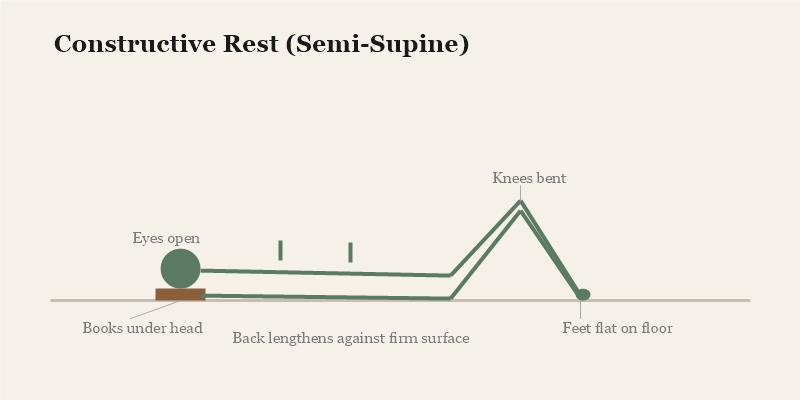
If you've ever taken an Alexander Technique lesson, one of the first things your teacher probably had you do was lie on the floor. Not on a mattress. Not on a yoga mat. The floor.
Books under your head. Knees bent. Feet flat. Eyes open. This is constructive rest — also called semi-supine — and it's one of the most powerful tools in the AT practitioner's toolkit.
But here's what most people don't ask: if the floor is so good for your body during constructive rest, what does that tell us about the surface you sleep on for 8 hours every night?
Why AT uses the floor
The floor provides three things that your body's nervous system needs to self-organize:
- Proprioceptive feedback. A firm surface pushes back against your body. Your nervous system receives clear data: "my shoulder blade is here, my sacrum is here, my heels are here." This information allows your muscles to calibrate and release.
- Skeletal support. When the surface is firm enough, your skeleton does the structural work of holding you up. Your muscles get the message that they can let go — because the bones are doing their job.
- Non-interference. The floor doesn't have opinions about what shape your spine should be. It doesn't push up into your lumbar region. It doesn't cradle your shoulders. It simply provides a stable, consistent platform and lets your body organize itself.
Now consider what a memory foam mattress does
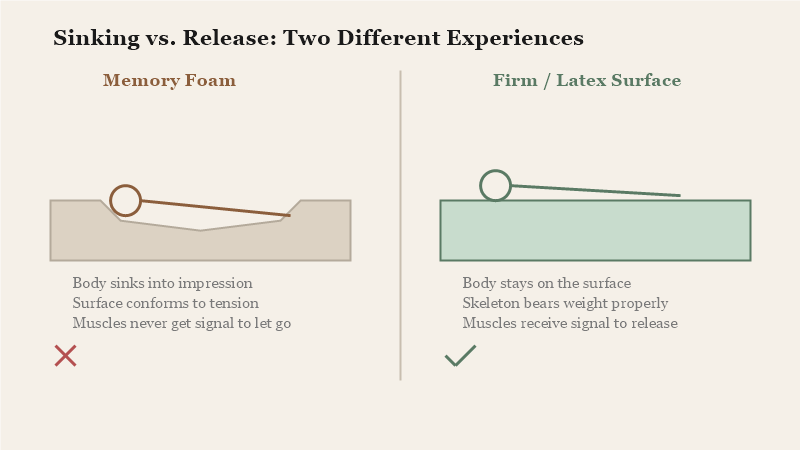
Memory foam does the opposite of all three:
- It removes feedback. The foam conforms to your body, which means your nervous system loses the clear contact-point data it needs. You can't feel where your shoulder blades are because the foam has filled in around them.
- It bypasses your skeleton. When you sink into foam, the surface is doing the structural work instead of your bones. Your muscles never get the signal to release because the foam got there first.
- It locks in your patterns. Memory foam molds to your body — but your body right now reflects years of habitual tension. The foam is conforming to your dysfunction, not your natural coordination.
What to look for instead
We're not saying you should sleep on the floor (though some AT practitioners do). We're saying that the qualities that make the floor good for constructive rest are the same qualities you should look for in a mattress:
- Responsiveness over conformity. Look for materials that push back — natural latex, pocketed coils, firm foam. Avoid materials that absorb and conform, especially memory foam.
- Simplicity over engineering. A mattress with "5-zone lumbar support" is making assumptions about your spine. A simple latex slab or coil system just provides a platform and lets your body decide.
- Feedback over comfort. The mattress that feels instantly amazing in the showroom may be conforming to your tension patterns. A surface that feels slightly unfamiliar but provides clear sensory information may serve you better long-term.
This is why we built our 6-pillar review framework — to evaluate mattresses on the criteria that actually matter for body awareness, not the criteria the mattress industry invented to sell you softness.
See how specific mattresses score, or take our body awareness quiz to find the right one for where you are in your AT journey.