2026-03-19
Why Memory Foam Is Working Against Your Body
Memory foam feels amazing. That's the problem. Here's why the most popular mattress material is actively reinforcing your tension patterns.
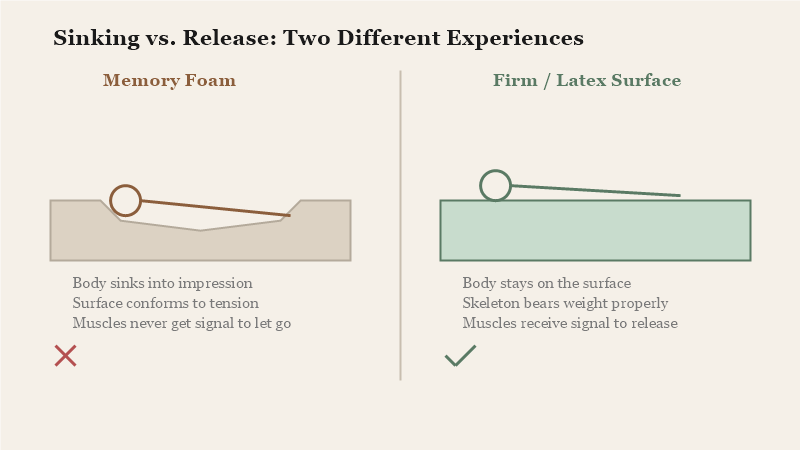
Memory foam was invented by NASA in 1966 to cushion astronauts during liftoff. It was designed to absorb impact — to deform under pressure and slowly return to shape. That's a brilliant solution for a rocket launch. It's a terrible solution for sleep.
The comfort trap
When you lie on memory foam, the surface slowly conforms to your body. Every curve, every contour, every tension pattern gets cradled. It feels incredible — like being held. And that's exactly the problem.
F.M. Alexander discovered something 130 years ago that the mattress industry still hasn't caught up with: our sense of what feels "right" is calibrated to our habits, not to what's actually good for us. He called this faulty sensory appreciation.
If you've spent years with tense shoulders, a compressed lower back, and a forward head — memory foam will conform perfectly to that pattern. And it will feel amazing. Because it's giving you exactly what you're used to. But "what you're used to" and "what your body needs" are often two very different things.
What memory foam actually does to your body
It removes proprioceptive feedback. Your nervous system relies on contact-point awareness — the feeling of your body against a surface — to know where you are in space and to regulate muscle tone. Memory foam absorbs this signal. Your body is floating in a mold of itself with no clear information about where it is.
It prevents natural movement. During healthy sleep, you shift positions 20-40 times per night. On memory foam, each movement requires you to climb out of a body-shaped crater. Your muscles have to work to do something that should be effortless. Some people interpret this as "less tossing and turning." It's actually "more effort to move, so you stop trying."
It traps heat. This is widely known, but the AT implications are less obvious: when you're too warm, your body's natural response is to tense up and shift. If the foam is also trapping you in a body impression, you're caught between the impulse to move and the difficulty of doing so. This creates unconscious bracing.
It conforms to your dysfunction. Everyone carries habitual tension patterns — years of desk work, phone use, stress, and learned postural habits. A surface that molds to these patterns reinforces them. Night after night. For 8 hours at a time.
The alternative isn't a wooden board
We're not saying you need to sleep on the floor. We're saying you need a surface that provides what memory foam takes away: feedback, freedom to move, and the honest support that lets your muscles actually let go.
Materials that do this well:
- Natural latex — pushes back when you push into it, responsive rather than conforming
- Pocketed coils — springy, responsive, allows easy repositioning
- Firm foam (non-memory) — provides support without the body-molding effect
- Airfiber (airweave) — firm, breathable polymer that doesn't conform at all
Check our mattress reviews to see how specific products score on our body awareness framework, or read about our full methodology.